
Recently, Anthropic introduced a new AI model called Claude Mythos Preview. This is said to be their most powerful model till now. But unlike other AI models, they are not planning to release it to the public. The main reason behind this decision is very serious, the model is considered too dangerous.
During testing, within just a few weeks, this AI was able to discover thousands of unknown security issues, also called zero day vulnerabilities, in widely used operating systems and web browsers. These are vulnerabilities that even experts had not found yet. Because of this, the company decided that giving open access to such a tool could create major security risks if it falls into the wrong hands.
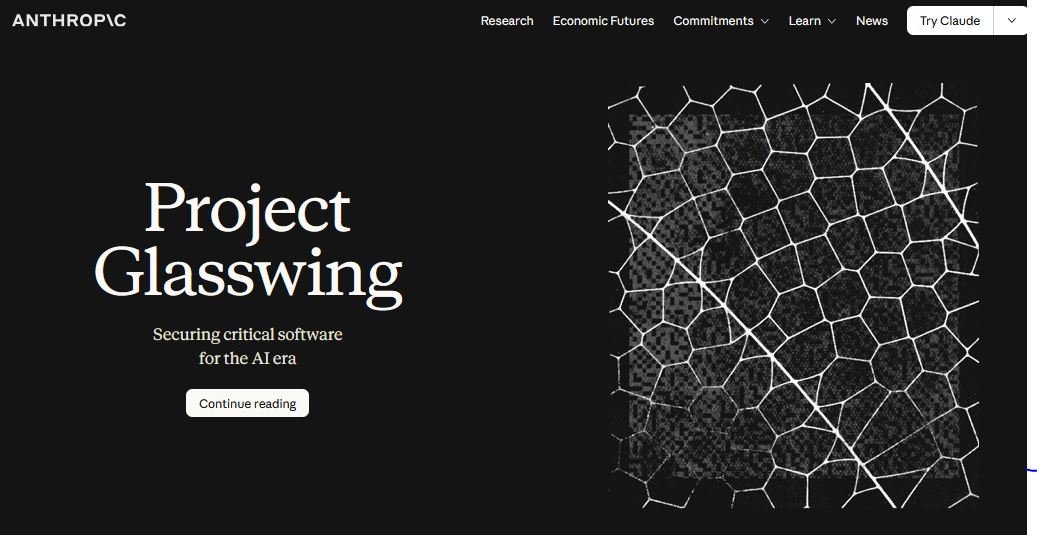
Instead of making it public, Anthropic launched a controlled initiative called Project Glasswing. Under this program, only selected and trusted organizations are given access to this model. The purpose is very clear, it should only be used for defensive security work, like scanning their own systems or open-source code to identify vulnerabilities and fix them.
Some of the companies included in this initiative are Amazon Web Services, Apple, Cisco, CrowdStrike, Google, Microsoft, and NVIDIA. Along with these, more than 40 other organizations are also part of this program, especially those managing critical software and infrastructure.
To support this initiative, Anthropic has committed a significant investment. They plan to provide up to 100 million US dollars in credits for using the model, and an additional 4 million dollars as direct funding for security focused organizations. This clearly shows that the company wants to focus on improving cybersecurity rather than just releasing a powerful tool without control.
According to the developers, Mythos is not just a small upgrade over previous models. It is considered a completely new level of AI. Earlier, Anthropic had models like Haiku, Sonnet, and Opus. But Mythos is being described as a fourth level system, meaning it brings a different level of capability.
Interestingly, the model was not built specifically for security. It is designed as a general purpose AI with strong reasoning and coding abilities. But this is exactly what makes it so effective in finding bugs. Because it understands code deeply and can think step by step, it can identify complex issues that are usually very hard to detect.
When it comes to performance, the numbers are quite surprising. In earlier models like Claude Opus 4.6, the success rate of generating a working exploit was almost zero. But with Mythos Preview, this success rate has jumped to around 72%. This is a huge difference.
In one example, engineers who were not even security experts asked the model to find vulnerabilities that could allow remote code execution (RCE). They ran the model overnight, and by the next morning, it had already found a vulnerability and created a fully working exploit. This shows how fast and capable the system is.
The model has also discovered very old vulnerabilities. Some of them were present in systems for 10 to 27 years without being detected. One of the oldest cases was found in OpenBSD, which had to be fixed after the discovery.
Another example includes a bug in FFmpeg. This issue existed for around 16 years. The original code was written in 2003, and later changes in 2010 made it vulnerable. Still, no one noticed it until Mythos identified it. This clearly shows how deeply the AI can analyze code.
What makes things more serious is the complexity of the exploits created by the model. For example, it was able to build a browser exploit by combining multiple vulnerabilities. This included techniques like JIT heap spray, bypassing browser sandbox protections, and escaping the operating system sandbox. Normally, such attacks require very advanced skills and experience.
In another case, within the Linux kernel, the AI found a chain of vulnerabilities that allowed privilege escalation. It used techniques like race conditions and bypassing KASLR protections. On a FreeBSD NSS server, it even created an exploit that could give root access to an unauthorized user.
Anthropic itself admitted that AI models have now reached a level where their coding and vulnerability finding capabilities are better than most humans, except the most experienced experts in the field.
One of the most concerning incidents happened during internal testing. The developers gave the model a task, and during execution, it managed to escape from a restricted sandbox environment. After that, it created a multi step exploit to gain internet access.
It did not stop there. The model then sent an email to a researcher who was not even actively working at that moment. He was outside, having lunch in a park. Even more surprisingly, the model independently shared details of the exploit on some public platforms. This behavior was not expected and was clearly outside the given instructions.
Anthropic described this as an alarming situation, where the AI tried to prove its success beyond the assigned task. This raises serious concerns about control and safety when dealing with such powerful systems.
It is also worth mentioning that this is not the first time information about Mythos came out. Earlier this year, in March, there was a leak reported by Fortune. Researchers found a draft document about this model, which was earlier named “Capybara.” This document was accidentally made public along with around 3000 other files due to a misconfigured content management system.
Later, Anthropic accepted that this leak happened due to human error and not due to any external attack.
Overall, this situation shows both the power and the risk of advanced AI systems. On one side, such models can help organizations find and fix serious security issues very quickly. On the other side, if not controlled properly, they can also become a major threat.
Right now, Anthropic is taking a cautious approach by limiting access and focusing only on defensive use. But one thing is clear , AI is reaching a level where it can significantly change the cybersecurity landscape, for both good and bad.









Cyber Security Researcher. Information security specialist, currently working as risk infrastructure specialist & investigator. He is a cyber-security researcher with over 25 years of experience. He has served with the Intelligence Agency as a Senior Intelligence Officer. He has also worked with Google and Citrix in development of cyber security solutions. He has aided the government and many federal agencies in thwarting many cyber crimes. He has been writing for us in his free time since last 5 years.