
Introduction
Most people think a Wi-Fi router is only used for internet. We install it in our homes, offices, and schools so that laptops, phones, and smart TV’s can connect to the internet wirelessly. But modern research has shown that Wi-Fi signals can do much more than just carry internet data. Surprisingly, the same Wi-Fi signals can also detect human movement inside a room and even they can watch you while you are at home.
This technology is known as Wi-Fi motion detection. Instead of using cameras or sensors, it uses radio waves already present in the environment. These radio waves bounce off objects and people. By studying how the signals change, computers can understand if someone is moving in the room. In some advanced WiFi systems, it can even identify gestures or detect breathing.
This idea sounds like science fiction, but it is already being researched by universities and technology companies. The interesting part is that it works without cameras, which makes it different from traditional surveillance systems.
Understanding WiFi Radio Waves
WiFi works using radio waves. These waves are part of the electromagnetic spectrum, which also includes visible light, X-rays, and microwaves. The Wi-Fi signals we use at home normally operate in the 2.4 GHz, 5 GHz, and sometimes 6 GHz frequency bands.
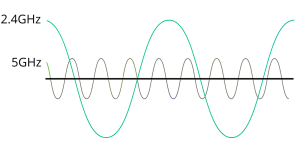
A frequency measured in gigahertz (GHz) simply tells us how fast a wave oscillates. For example:
- 2.4 GHz WiFi travels farther and passes through walls more easily.
- 5 GHz WiFi provides faster data speeds but covers a shorter distance.
- 6 GHz WiFi, used in newer Wi-Fi 6E routers, offers even more bandwidth.
When a WiFi router sends signals, the radio waves spread throughout the room. They bounce off walls, furniture, and people. These reflections change the signal slightly. Normally, we ignore these small changes because they do not affect internet browsing much. However, researchers realized that these tiny variations contain useful information.
By carefully measuring how WiFi signals change when they reflect off a human body, it becomes possible to detect movement.
What is Channel State Information (CSI)?
One of the key concepts behind WiFi motion detection is something called Channel State Information, commonly known as CSI.
To understand CSI, imagine that Wi-Fi signals travel from the router to your laptop through many paths. Some signals go directly, while others bounce off walls or objects before reaching the device. Because of these different paths, the signal strength and phase change slightly.
CSI measures these changes in detail.
It describes how a wireless signal behaves while traveling through the environment. In simple terms, CSI records:
- Signal strength
- Signal phase
- Signal delay
- Changes caused by reflections
When a person moves in a room, their body blocks or reflects Wi-Fi signals. This movement changes the CSI values. Even small movements such as raising a hand or turning the head can slightly change how signals travel.
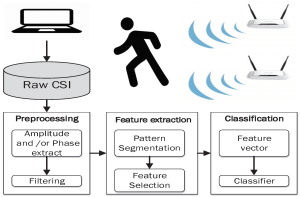
Computers can monitor CSI values continuously. If the CSI pattern changes, the system knows something moved in the room.
How Human Bodies Affect WiFi Signals
Human bodies interact with radio waves in several ways. Our bodies contain water and minerals that absorb and reflect electromagnetic signals. When Wi-Fi waves hit a person, some signals are absorbed while others bounce back.
This reflection changes the signal pattern.
For example:
- If a person walks across a room, the reflected signals shift continuously.
- If someone raises a hand, the signal reflection changes slightly.
- Even breathing causes small movements in the chest, which slightly alters the signal.
These changes may be extremely small, but modern Wi-Fi hardware can measure them very precisely.
Because of this, researchers discovered that Wi-Fi signals can detect:
- Walking
- Sitting or standing
- Hand gestures
- Body movements
- Breathing patterns
This means Wi-Fi networks can act as motion sensors, even though they were originally designed only for communication.
Creating 3D Silhouettes Using WiFi
A silhouette is a dark, solid shape or outline of a person, animal, or object, typically seen against a light background. Some advanced research systems go even further. They can reconstruct a 3D silhouette of a human body using Wi-Fi signals.
This works by analyzing how signals bounce off different parts of the body. Since different body parts move differently, they create unique reflection patterns. For example:
- Arms move differently than legs.
- The head reflects signals differently than the torso.
- Walking creates repeating patterns.
By collecting signal reflections from multiple Wi-Fi antennas, a computer can estimate the shape and movement of the person. Artificial Intelligence (AI) models are then used to interpret these patterns.
The result is not a clear photographic image like a camera. Instead, it produces a stick-figure or silhouette representation showing the position of the body.
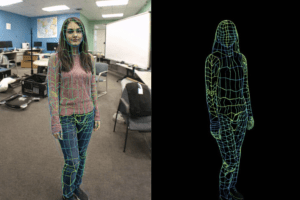
Several research projects have demonstrated this idea. Systems like WiSee, WiTrack, and RF-Pose showed that WiFi signals can detect body movements and gestures with impressive accuracy.
Using Artificial Intelligence to Understand Movements
The raw CSI data collected from Wi-Fi signals is very complex. It contains many small variations that humans cannot easily interpret. This is where Artificial Intelligence (AI) and Machine Learning come in.
Machine learning algorithms are trained to recognize patterns in the signal data. During training, the system observes different activities such as:
- Walking
- Sitting
- Waving a hand
- Falling down
- Breathing
The AI model learns how each activity changes the CSI pattern. Once trained, it can identify similar patterns in real time.
For example:
If the signal pattern matches the pattern learned for walking, the system concludes that someone is walking in the room.
Deep learning models such as neural networks are particularly useful because they can recognize very subtle patterns in signal data. This allows the system to detect complex gestures or body poses.
Detecting Movement Through Walls
One fascinating feature of Wi-Fi sensing is that it can sometimes detect movement through walls.
Wi-Fi radio waves can pass through materials like wood, drywall, and glass. When they pass through walls, they still interact with objects and people inside the room.
Because of this, WiFi sensing systems can detect motion even when the router is outside the room.
This ability has several potential uses:
- Detecting intruders in buildings
- Monitoring elderly people for falls
- Smart home automation
- Search and rescue operations
For example, in a smart home, WiFi sensing could automatically turn on lights when someone enters a room without using motion sensors.
In healthcare, it could monitor breathing patterns of patients without attaching any sensors to the body.
Privacy Concerns
Even though Wi-Fi sensing does not use cameras, it still raises privacy concerns.
If someone can detect movement through walls using Wi-Fi signals, it might allow monitoring of people without their knowledge. This could create ethical and legal issues.
For example:
- Unauthorized surveillance in homes
- Tracking human activities secretly
- Monitoring neighbors or nearby buildings
Because of this, researchers are discussing privacy protections. Some solutions include limiting sensing range, encrypting CSI data, or requiring user permission before enabling Wi-Fi sensing features.
Governments and technology companies will likely need to develop clear rules about how this technology can be used.
Conclusion
Wi-Fi routers were originally designed to provide wireless internet connectivity. However, researchers discovered that the same radio signals used for communication can also sense human movement.
By analyzing Channel State Information (CSI) and using Artificial Intelligence, Wi-Fi systems can detect motion, recognize gestures, and even create rough 3D silhouettes of people. These signals can sometimes pass through walls, allowing movement detection without cameras.
This technology opens new possibilities for smart homes, healthcare monitoring, and security systems. At the same time, it also raises important privacy concerns that must be addressed carefully.









Cyber Security Researcher. Information security specialist, currently working as risk infrastructure specialist & investigator. He is a cyber-security researcher with over 25 years of experience. He has served with the Intelligence Agency as a Senior Intelligence Officer. He has also worked with Google and Citrix in development of cyber security solutions. He has aided the government and many federal agencies in thwarting many cyber crimes. He has been writing for us in his free time since last 5 years.