Imagine having a team of expert cybersecurity professionals working around the clock to inspect software for security weaknesses. Now imagine that team is made up of AI assistants that can work together, share information, and produce detailed reports in a fraction of the time.
This is the idea behind T3MP3ST, an open-source framework that is changing the way security researchers test software. Instead of relying on a single AI assistant, T3MP3ST coordinates multiple AI coding agents to work as a team. The result is faster and more organized vulnerability discovery.
Although AI will not replace experienced cybersecurity professionals anytime soon, tools like T3MP3ST show that artificial intelligence is becoming a valuable partner in finding software vulnerabilities before cybercriminals do.
What Is T3MP3ST?
T3MP3ST is an open-source framework designed for authorized security testing. It does not contain its own artificial intelligence model. Instead, it acts as a coordinator that manages AI coding assistants such as Claude Code, OpenAI Codex, and Hermes.
Think of T3MP3ST as the manager of a security team.
Instead of one person doing everything, the manager assigns different tasks to different experts. One AI explores the software, another studies the source code, another searches for security flaws, and another prepares the final report.
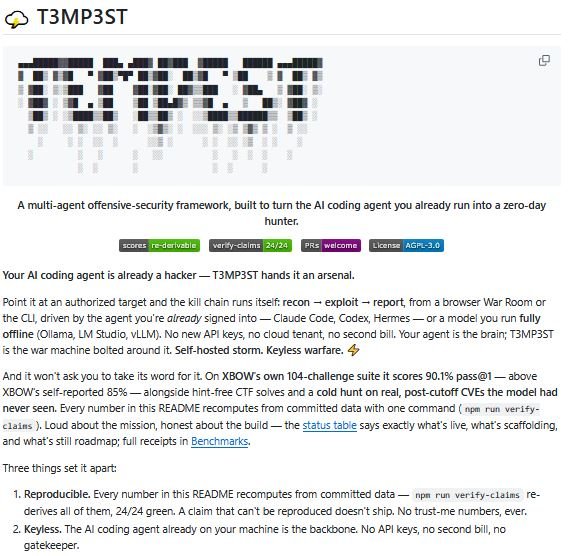
This teamwork allows the system to work more efficiently than using a single AI assistant.
Why Is This Different?
Traditional vulnerability hunting requires skilled cybersecurity professionals who manually inspect thousands or even millions of lines of code. This process takes time, experience, and patience.
T3MP3ST changes this approach by automating much of the work.
It can:
- Explore software automatically.
- Analyze source code.
- Identify possible security weaknesses.
- Record findings.
- Generate reports for security teams.
The framework also works with AI sessions already running on a user’s computer, meaning users do not need to purchase additional API keys or build separate cloud infrastructure.
This makes the tool easier to use for researchers who already work with AI coding assistants.
How Does It Work?
T3MP3ST follows a simple workflow.
Step 1: Reconnaissance
The AI studies the target application and collects information about its structure.
Step 2: Analysis
The AI examines files, functions, and code logic to understand how the software works.
Step 3: Vulnerability Hunting
The agents search for coding mistakes that attackers could exploit.
Examples include:
- Buffer overflows
- Authentication problems
- Input validation issues
- Logic errors
- Memory management bugs
Step 4: Reporting
The AI prepares a detailed report showing:
- The affected file
- The exact line of code
- The type of vulnerability
- Supporting evidence
Instead of producing random guesses, the framework aims to provide useful information that developers can use to fix problems.
How Well Does It Perform?
According to published testing results, T3MP3ST has shown impressive performance on benchmark security tests.
https://github.com/elder-plinius/T3MP3ST/blob/main/FEATURES.md
In one benchmark called XBEN, it solved more than 90% of vulnerability-finding tasks on the first attempt, outperforming earlier approaches.
Another benchmark called Cybench showed that a single AI agent successfully solved more than half of the security challenges without receiving hints.
Perhaps the most interesting test involved ten real-world software vulnerabilities that became publicly known in 2026.
A single AI agent correctly identified:
- the affected source file,
- the exact line of code,
- and the vulnerability type
for eight out of ten cases.
When multiple AI agents worked together, they successfully found all ten vulnerabilities.
Because these vulnerabilities were disclosed after the AI models had already been trained, researchers believe the framework was reasoning about the code instead of simply recalling previously learned examples.
Why Does This Matter?
Software is becoming more complex every year.
Large applications may contain millions of lines of code, making manual security reviews increasingly difficult.
Organizations also release software updates much faster than before.
This creates a challenge for security teams because vulnerabilities can remain hidden for months.
AI-powered tools like T3MP3ST can help developers identify security issues much earlier in the software development process.
Earlier detection means:
- Lower remediation costs
- Better software quality
- Faster security reviews
- Reduced risk of cyberattacks
Rather than replacing human experts, these tools allow security professionals to spend more time investigating complex issues instead of searching for basic coding mistakes.
Current Limitations
Despite its impressive results, T3MP3ST is still under active development.
Some capabilities are considered stable, including:
- Software reconnaissance
- Single-agent operational workflow
Other features remain experimental, such as coordinating many AI agents simultaneously for larger security assessments.
Like every AI system, T3MP3ST can also make mistakes.
Human verification is still essential before confirming that a vulnerability is genuine.
Responsible Use Is Essential
The developers clearly state that T3MP3ST is intended only for:
- Authorized penetration testing
- Security research
- Education
- Defensive cybersecurity
Using the framework against systems without permission is illegal in many countries.
Ethical hacking always requires written authorization from the owner of the target system.
Open-source security tools are designed to help organizations improve their defenses – not to attack unauthorized targets.
What Does This Mean for the Future?
The cybersecurity industry is entering a new era.
For years, AI has been helping developers write software. Now it is beginning to help secure that software as well.
Future security teams may consist of both human experts and AI agents working together. Humans will make strategic decisions, while AI handles repetitive code analysis and vulnerability discovery.
This partnership could dramatically reduce the time required to identify security flaws and improve the overall security of software worldwide.
Final Thoughts
T3MP3ST demonstrates how quickly AI-assisted cybersecurity is evolving. By coordinating multiple AI coding assistants into a single workflow, it transforms ordinary coding tools into powerful vulnerability-hunting assistants.
Although it is not a replacement for experienced security professionals, it can significantly improve productivity, accelerate code reviews, and help organizations discover security issues before attackers do.
As AI continues to improve, frameworks like T3MP3ST may become a standard part of secure software development, allowing organizations to build safer applications while reducing the effort needed for vulnerability assessment.
The future of cybersecurity is not humans versus AI it is humans and AI working together to build more secure software.








Cyber Security Researcher. Information security specialist, currently working as risk infrastructure specialist & investigator. He is a cyber-security researcher with over 25 years of experience. He has served with the Intelligence Agency as a Senior Intelligence Officer. He has also worked with Google and Citrix in development of cyber security solutions. He has aided the government and many federal agencies in thwarting many cyber crimes. He has been writing for us in his free time since last 5 years.